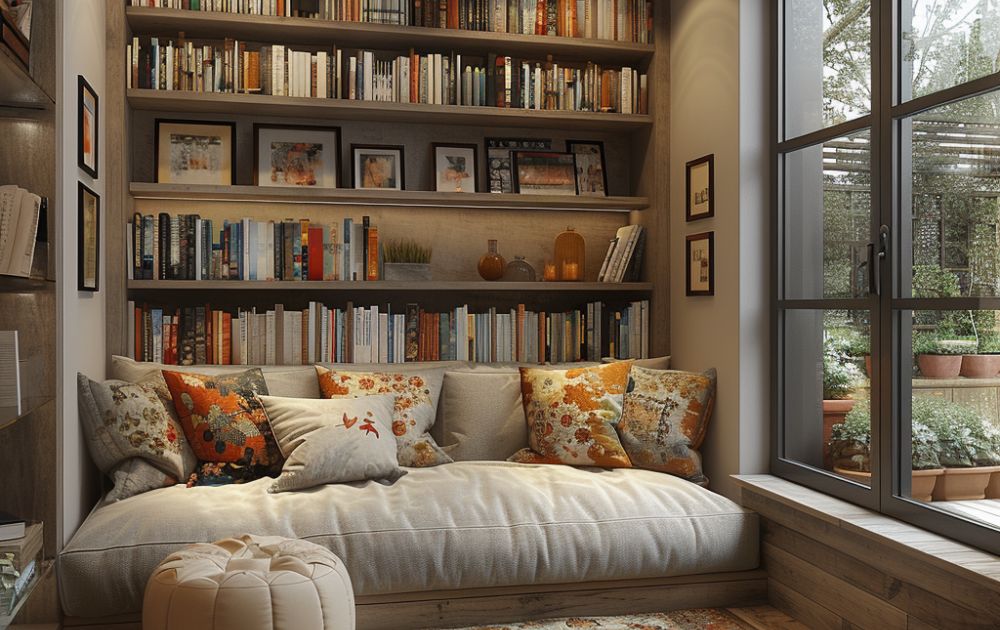
There’s a particular kind of quiet that only happens in a room full of books. Not silence, exactly — more like the sound gets softer, the light gets warmer, and time stops rushing you. If you’ve ever walked into a home with a dedicated reading corner or a wall of floor-to-ceiling shelves and felt your shoulders drop an inch, you already understand why home library ideas have become one of the most searched home-design topics in the country.
Table of Contents
This isn’t a list of untouchable showroom photos. It’s a guide built from real rooms, real budgets, and a few lessons I learned the hard way — plus one very specific bookstore in Oregon that changed how I think about shelves entirely. Whether you’re working with a spare bedroom, a stair landing, or just one empty wall, there’s a home library idea here that will fit your actual house, not just a fantasy one.
We’ll walk through what actually makes a reading space work before touching style, then move through a full photo gallery of 16 real home library ideas — spanning modern home library design, farmhouse home library styling, rustic bookshelf ideas, and the minimalist reading room look. After that, we’ll get practical: how to choose the right idea for your space, ideas organized by room type and by budget, the mistakes worth avoiding, and how to keep a home library looking good for decades instead of just one season.
Why I Fell for the Idea of a Home Library
A few years ago I spent an afternoon at Powell’s City of Books in Portland, Oregon — a full city block of new and used books stacked three stories high. I didn’t buy much that day. What I brought home instead was an obsession with the feeling of being surrounded by spines, ladders, and reading nooks tucked into corners nobody expected.
At the time, my “library” was a single Billy bookcase wedged between a window and a radiator. It held maybe sixty books, half of them stacked sideways because I’d run out of vertical space. It worked, technically. But it didn’t feel like anything.
Rebuilding that corner into an actual home library idea — even a small one — turned out to be less about money and more about intention. I moved the bookcase away from the radiator (heat warps paperbacks faster than anyone warns you), added a single armchair angled toward the window instead of the TV, and hung one warm-toned lamp instead of relying on the overhead light. That was it. Three changes. The room stopped being “the place with the bookcase” and started being “the reading room.”
That’s really the heart of every idea in this guide: a home library isn’t defined by square footage. It’s defined by whether the room invites you to sit down and stay.
What Actually Makes a Home Library Idea Work
Before getting into specific styles, it helps to know what separates a home library that gets used daily from one that just looks nice in photos and collects dust. A few principles show up again and again in the best home library ideas:
- A clear reading seat. Every good library has one obvious place to sit — a chair, a window bench, a daybed — positioned near natural light.
- Shelving that’s actually reachable. Books above eye level or below the knee rarely get pulled down. Prime real estate is chest-to-eye height.
- Warm, layered lighting. A single overhead bulb makes any room feel like an office. Table lamps, sconces, or even string lights change everything.
- A soft surface underfoot. A rug does more to make a library feel like a room (and not a hallway of shelves) than almost anything else.
- Room to grow. The best home library ideas leave a little slack — a half-empty shelf, a spare basket — because book collections never stop growing.
Keep these five things in mind as you scroll through the gallery below, because the aesthetic changes completely from modern to rustic, but these fundamentals stay the same in every single one.
16 Home Library Ideas to Steal (Full Photo Gallery)
Here’s the full collection — sixteen real home library ideas covering every style, from airy modern home library design to deep, dramatic rustic bookshelf ideas. Use this section as a mood board: save the two or three that feel most like your own house, and build outward from there.
SConservatory Library.
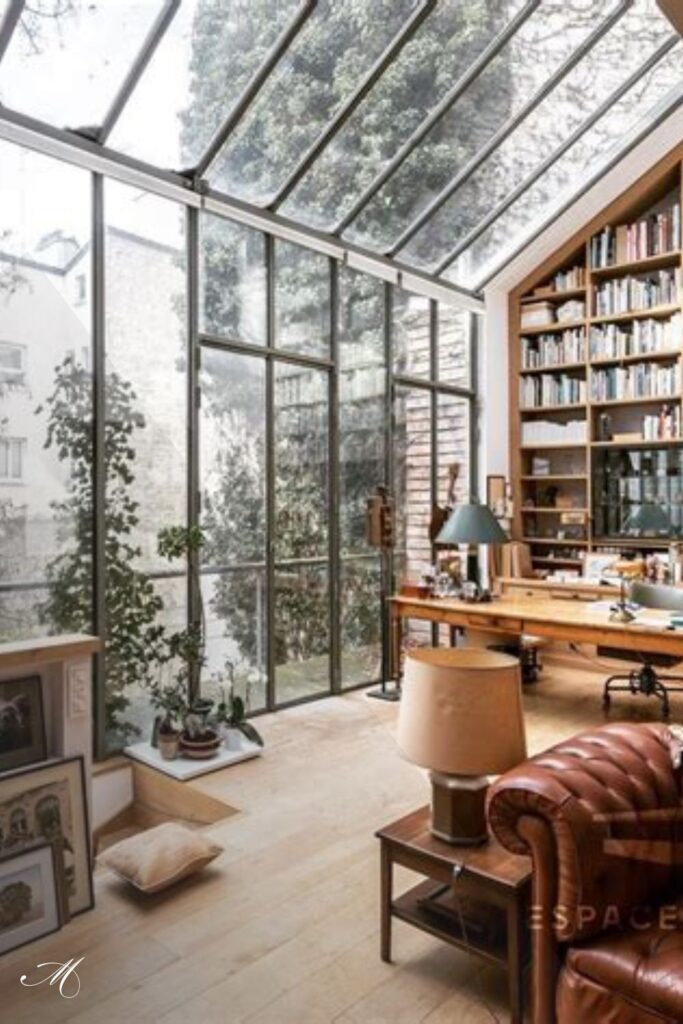
A glass-roofed sunroom turned into a full reading room, with an exposed brick wall on one side, a tufted leather chesterfield anchoring the seating area, and a single run of built-in shelving tucked into the one solid wall the glazing doesn’t cover. Layered kilim-style floor cushions and framed prints leaning against the brick keep the space from feeling too austere despite all that glass.
Why it works: most people assume a library needs four solid walls to feel cozy, but this room proves the opposite — the brick and leather add enough weight and warmth that the glass roof and walls read as a feature, not a liability. It’s a strong reference for anyone converting a porch, sunroom, or garden room, since it shows how to ground an all-glass structure with just one material-rich wall instead of fighting the light with heavy drapery.
How to recreate it: paint or expose one wall in a rich, textured material (brick, reclaimed wood, or a deep color), keep the shelving run shallow and low so it doesn’t compete with the windows, and choose leather or another substantial upholstery fabric for the seating so the furniture holds its own against all that glass and daylight. Add a UV window film if the room gets strong afternoon sun, since sunrooms are the fastest place in a house for book spines to fade.
The Classic Window Library.
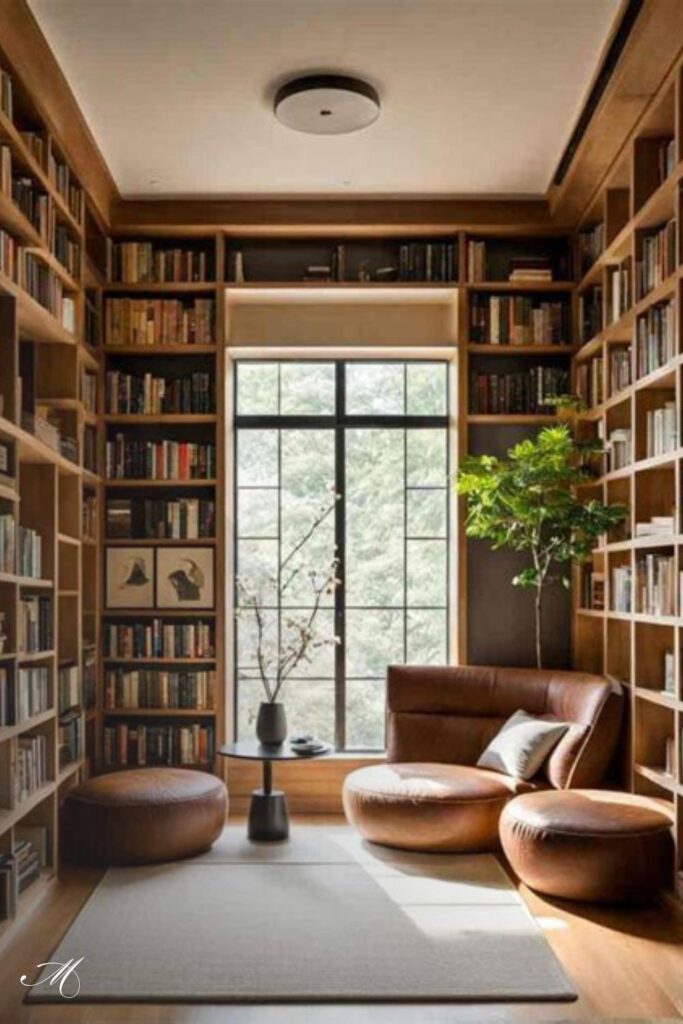
Full-height oak shelving on either side of a tall black-framed window, a cream wingback-style armchair and matching ottoman angled into the light, a slim pedestal side table for a drink or a stack of books, and a neutral wool rug grounding the whole corner. A single potted tree fills the gap where shelving stops short of the ceiling.
Why it works: this is close to the platonic ideal of a home library idea, and it’s worth studying in detail because almost every other style in this list is a variation on it. The symmetry of the shelving on both sides of the window keeps the eye centered, the warm wood tone contrasts cleanly against the black window frame, and the chair is angled just enough to catch daylight without a glare hitting the pages.
How to recreate it: if you have a single window on an interior wall, this layout scales down easily — even two narrow 12-inch bookcases flanking a smaller window will borrow the same visual logic. Keep the chair fabric light and the wood tone medium-to-warm so the whole corner doesn’t read as heavy, and use open shelving rather than glass-front cabinets so the books themselves stay the visual focus.
Cozy Farmhouse Nook.
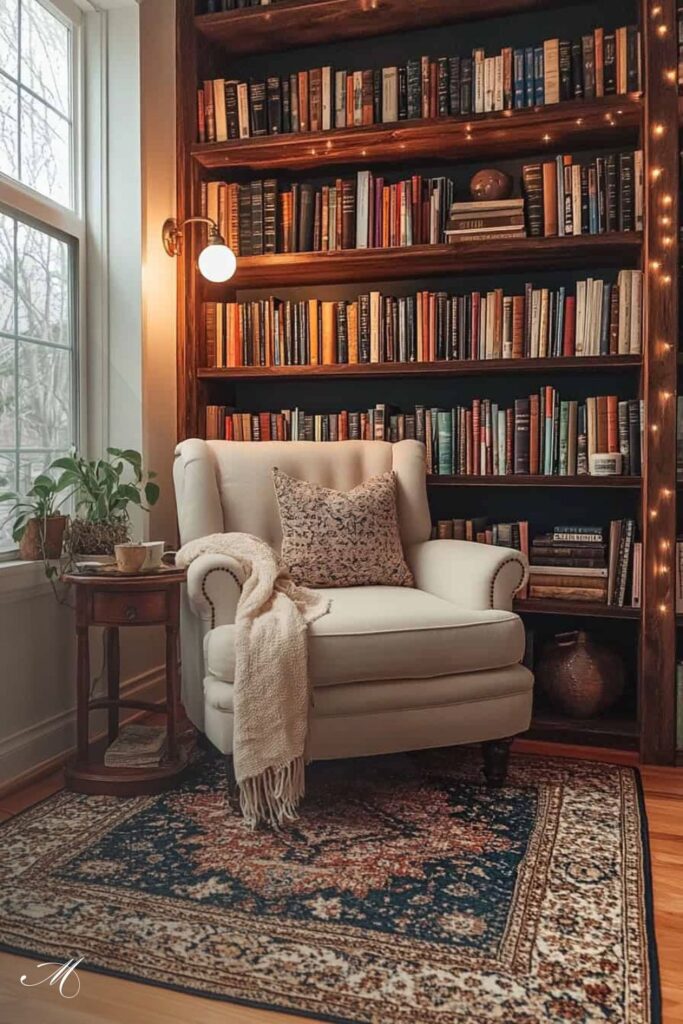
Dark stained wood shelving stacked floor to ceiling, a slouchy cream armchair with a chunky knit throw draped over one arm, a patterned rug in deep navy and rust tones, and a wall-mounted sconce paired with warm string lights woven along the shelf edges instead of relying on a single overhead fixture. A small round side table holds a mug and a candle within arm’s reach of the chair.
Why it works: this is a textbook farmhouse home library because every material choice leans toward “collected over time” rather than “installed last week.” The mismatched glow of the sconce and string lights avoids the flat, even lighting of recessed cans, and the worn-in rug pattern does a lot of work making the whole corner feel lived-in rather than staged.
How to recreate it: string lights are the cheapest, lowest-commitment way to test this look before committing to anything else — tuck a warm-white LED strand along two or three shelf edges and see how much the mood shifts. Pair with a vintage-style rug (secondhand or new) and one genuinely soft throw blanket, and resist the urge to organize the books too rigidly; a slightly uneven shelf reads more farmhouse than a color-coordinated one.
The Daybed Library.
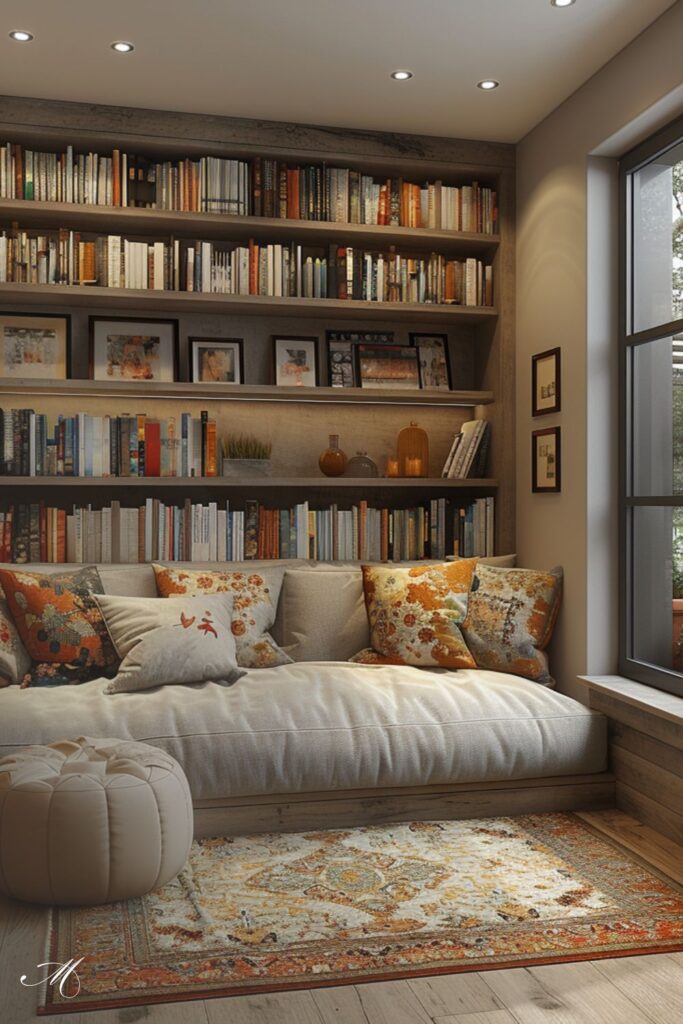
Built-in shelving in a warm driftwood tone runs the full width of the wall, with a long upholstered daybed built directly beneath it instead of the usual single armchair. A row of framed prints and small objects breaks up two of the shelves at eye level, and an abundance of rust, ochre, and cream patterned pillows keeps the daybed from reading as too plain or too formal.
Why it works: swapping a chair for a daybed changes the entire function of the room — it becomes a place to stretch out for an afternoon, nap with a book, or fit two people side by side, not just perch for twenty minutes. The warm rust and orange palette against driftwood-toned wood is also a useful color story for anyone who wants a farmhouse feel without going as dark as Idea 3.
How to recreate it: a daybed or a deep window-seat-style bench works if you have at least 6 feet of wall length to work with; if you’re building from scratch, keep the bench roughly sofa-cushion height so it’s genuinely comfortable to sit up against, not just to lie flat on. Break up at least one or two shelves with framed art or objects rather than filling every inch with books, which is what keeps this look from feeling like straight storage.
Modern Loft Library.
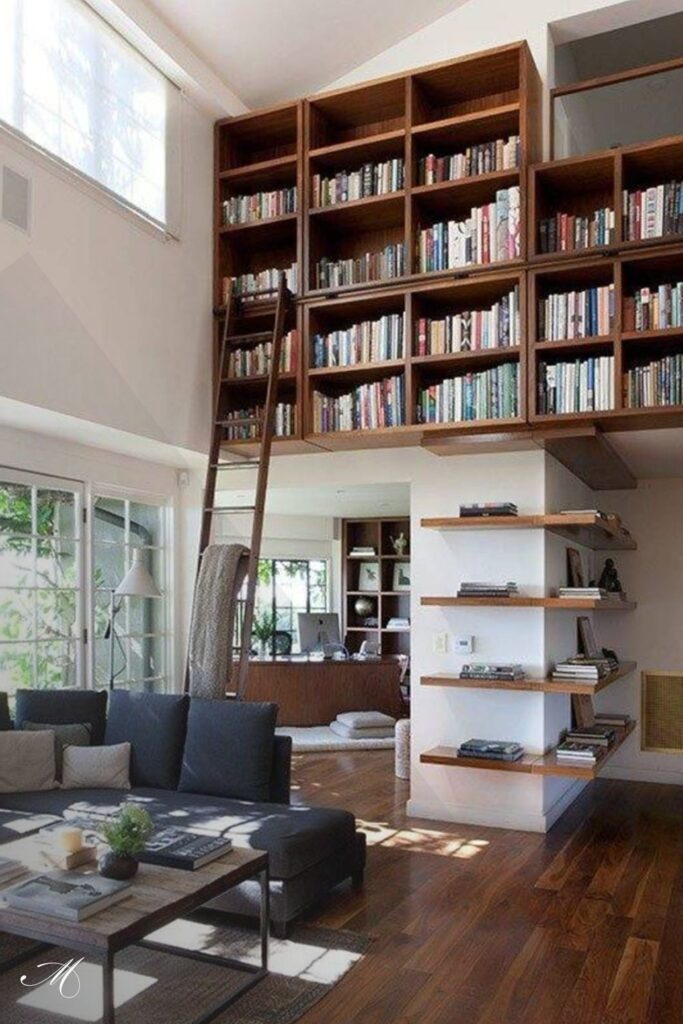
Double-height built-in shelving in a warm wood tone stacks two full stories above an open-plan living room, reached by a wheeled library ladder running on a black steel track. Below, a slim floating shelf wraps around a support column, and a dark sectional sofa and simple wood coffee table keep the living area underneath deliberately understated so the shelving reads as the room’s main event.
Why it works: this is one of the clearest real-world examples of modern home library design because it solves a problem most tall-ceilinged rooms have — a huge amount of wasted vertical space — by turning it directly into storage instead of decoration. The restrained, single-wood-tone palette and exposed steel ladder track keep it from feeling heavy or dated despite the sheer scale of the shelving.
How to recreate it: this look depends on structural planning more than any other idea here — the ladder track needs to anchor into framing, not just drywall, and the shelving itself typically needs engineering sign-off at this height. If you don’t have double-height ceilings, you can still borrow the principle at a smaller scale: extend a single bookcase to the ceiling and add a short library ladder rather than a step stool.
The Rounded Library Room.
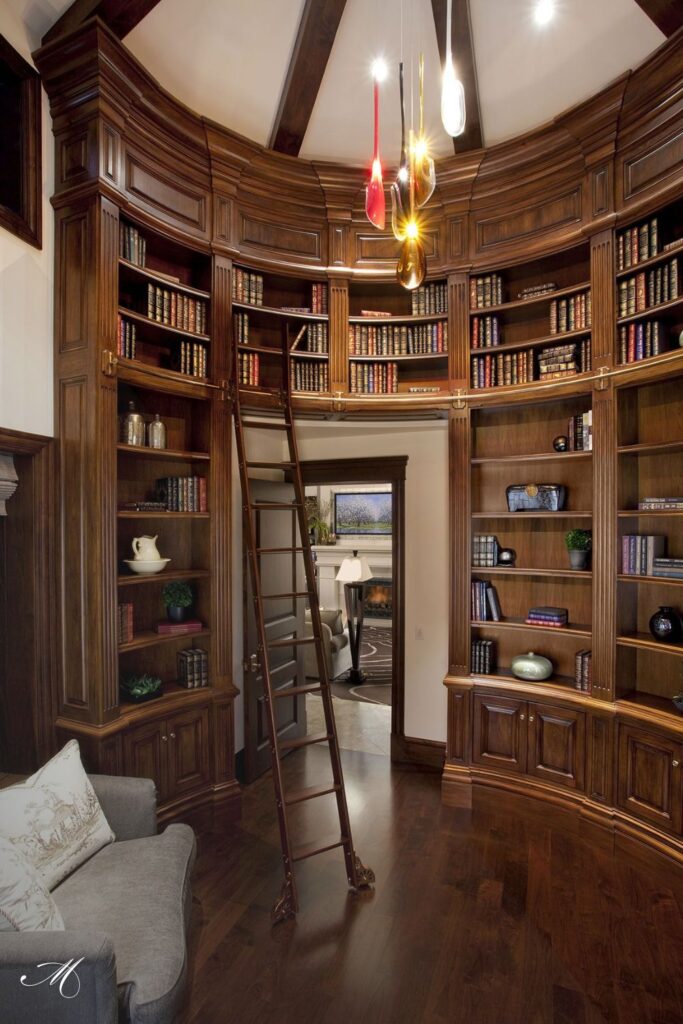
A curved wall of dark wood millwork wraps a small circular sitting area, with a library ladder on a curved rail leading up to a second tier of shelving above a doorway. Sculptural blown-glass pendant lights in red, amber, and gold hang from exposed ceiling beams, and a pale gray sofa with white piping softens the otherwise dark, dramatic wood tones.
Why it works: curved millwork is significantly more expensive and complex to build than straight shelving, which is exactly what makes this idea feel so distinctive — there’s no flat wall in the entire room, and the ladder’s curved rail mirrors the architecture instead of cutting across it. The colorful glass pendants are doing important work too, keeping a traditionally dark, formal material palette from feeling like a study from another century.
How to recreate it: full curved millwork is a custom-carpentry project, but you can borrow the spirit of this room without it — a rounded reading nook built into a bay or turret-style window, or simply a strong curved rug beneath standard shelving, hints at the same idea. The real, more accessible takeaway is the lighting: one or two statement pendant fixtures in a warm jewel tone can modernize even a very traditional, dark-wood library instantly.
Soft Transitional Library.
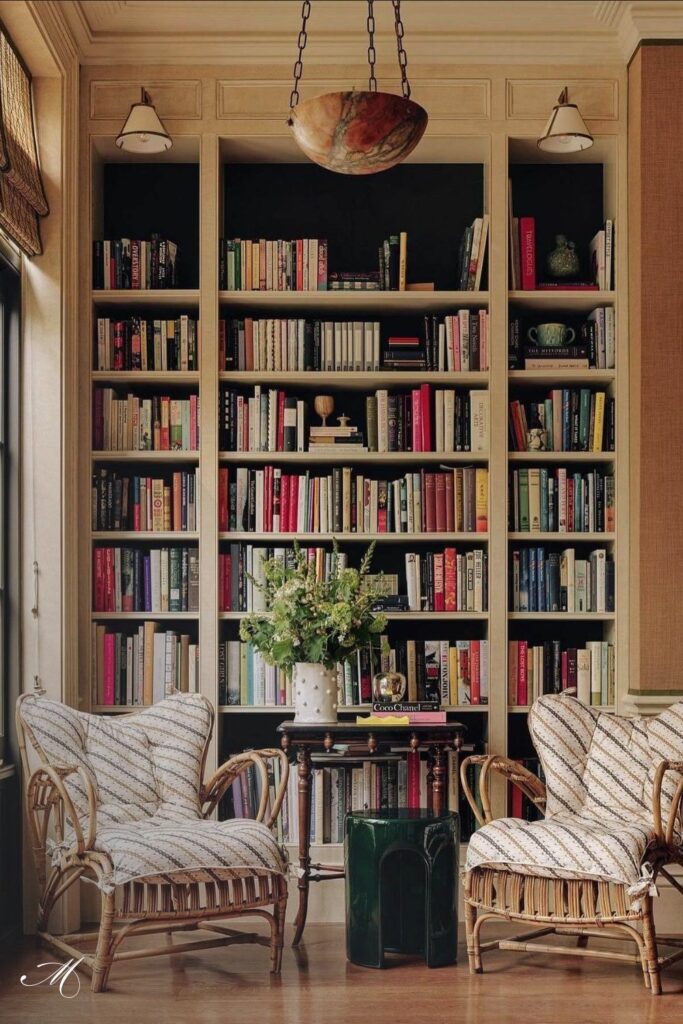
Cream-painted paneled built-ins frame a wall of shelving lit by brass picture-light sconces, with a domed alabaster pendant hanging center-stage. Two woven rattan lounge chairs with striped cushions face each other over a small green ceramic side table, rather than pointing toward a single focal wall.
Why it works: most home library ideas are designed around one person and one chair — this one is deliberately built for conversation, with two matching seats angled toward each other instead of toward the shelves. The cream paneling and brass lighting keep the palette soft and traditional without tipping into anything as dark or heavy as Ideas 6 or 16, which makes this a good middle-ground reference for a shared living room or parlor.
How to recreate it: brass picture lights mounted directly above the shelving are a relatively affordable way to get the warm, gallery-like glow this room has, even on an existing white or cream bookcase. If you want the “library as a place to talk” feeling, prioritize two matching chairs and a small shared table over a single oversized armchair — it changes how the whole room gets used.
Round Window Reading Corner.
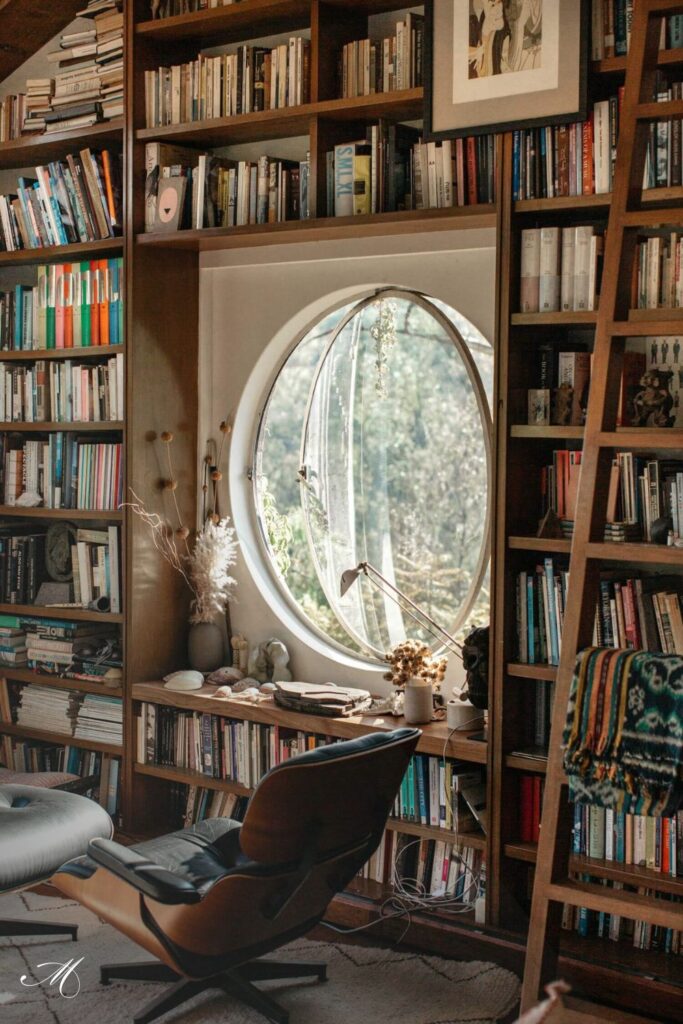
An architectural round window becomes the centerpiece of a dense, floor-to-ceiling wall of wood shelving, with a built-in ledge beneath it holding dried botanicals, small sculptural objects, and a task lamp. A tan-and-black leather lounge chair and ottoman sit just in front, and a library ladder leans against the neighboring shelving for reaching the upper rows.
Why it works: an oddly shaped architectural feature like a round window can be a design headache, but here it’s used as the entire reason the room works — the shelving is built to frame it rather than around it, turning what could be an awkward wall into the most memorable feature in the room. The dense, collected, unfussy book arrangement and mid-century lounge chair keep the room feeling like a working reading space rather than a showroom.
How to recreate it: if you have any non-standard window shape — round, arched, porthole — treat it the way this room does: build shelving that frames it symmetrically rather than shelving around it as an afterthought, and use the sill or ledge beneath it for small objects and a task lamp instead of leaving it empty. A single well-chosen lounge chair does more here than a full seating arrangement would.
Grand Two-Story Library.
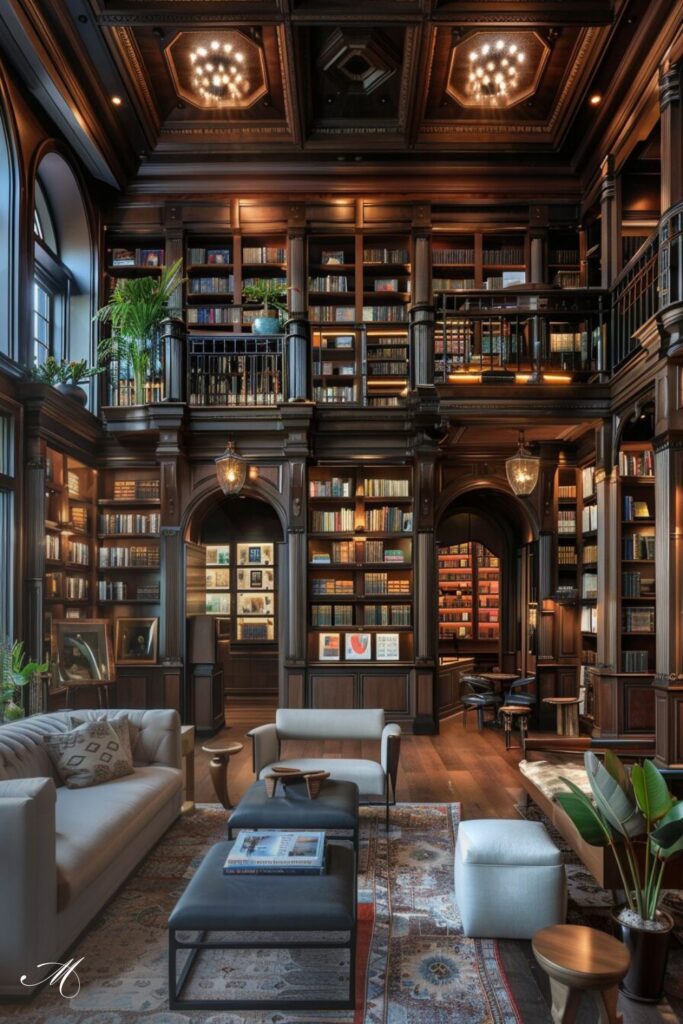
A full two-story library wrapped in dark wood shelving on every wall, with a railed balcony level accessed by a spiral or ladder connection, twin arched doorways leading to additional book-lined rooms beyond, and a pair of oversized octagonal coffered lighting fixtures overhead. Below, low-slung neutral sofas and ottomans create a generous seating area on a large patterned rug.
Why it works: this is the most ambitious idea in the whole gallery, and its value isn’t that most people will build it — it’s in showing what’s possible when a library is treated as the architectural centerpiece of a home rather than one room among many. The layered depth (shelving visible through the arched doorways beyond the main room) is what makes the space feel endless rather than just large.
How to recreate the feeling at a smaller scale: you don’t need two stories to borrow the key idea — a single doorway positioned so you can see shelving in the room beyond it creates a similar sense of depth and continuity. If you do have a genuine double-height room, splitting the shelving into a lower “everyday” tier and an upper “overflow and display” tier, connected by a ladder or a few open stairs, captures the same hierarchy this room uses.
Bohemian Plant Library.
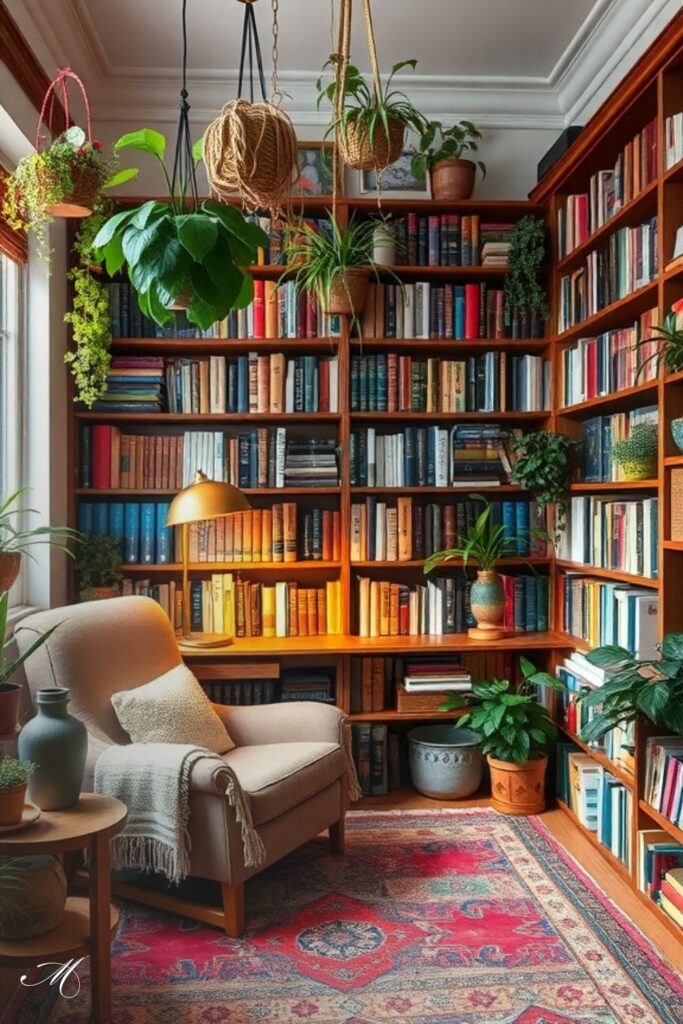
Warm honey-toned wood shelving is layered with color-sorted books, trailing pothos and spider plants hanging from macramé holders above the shelves, and a brass articulated lamp glowing against a wall of yellow and orange spines. A vividly patterned red-and-blue rug anchors a single upholstered armchair with a knit throw, and potted plants crowd the floor on every side.
Why it works: this is proof that a home library idea can be genuinely maximalist — dense with color, pattern, and greenery — and still feel calm rather than chaotic, because every element shares the same warm, saturated palette. The hanging plants also solve a problem most bookcases have: bare space above the top shelf, which here becomes some of the most visually active part of the room instead of dead air.
How to recreate it: color-sorting even one section of shelving (rainbow order, or just warm-to-cool) gives an instant, low-cost version of this look. Add one or two hanging planters from ceiling hooks or a curtain rod mounted just above the bookcase, and choose a rug with enough pattern and saturation to hold its own against the color-blocked spines — a plain neutral rug would undercut the whole effect here.
Family Den Library.
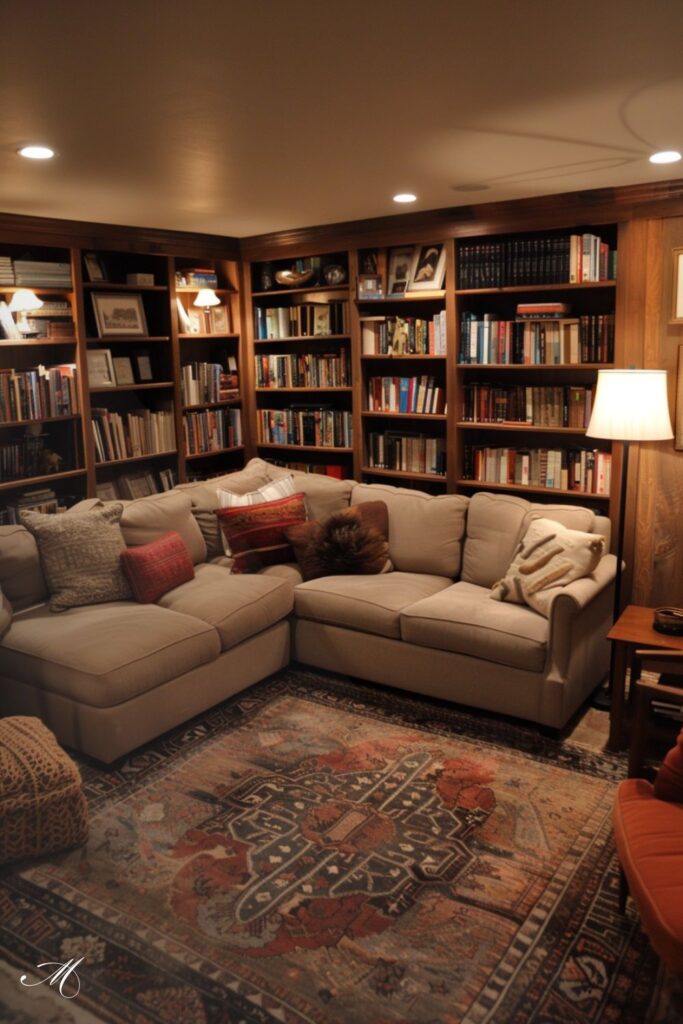
Dark wood built-ins wrap two full walls of a den, framing a deep, oversized sectional sofa layered with red, gray, and cream pillows. A tasseled floor pouf, a brass floor lamp, and a large antique-style Persian rug fill out a room clearly designed for hours of shared use rather than a quick solo read.
Why it works: most home library ideas are built around one reader in one chair — this one is built for a household. The sectional’s scale and the durable, patterned rug (which hides wear far better than a pale flatweave) both signal that this room is meant for daily life: movie nights, kids sprawled with homework, a couple reading side by side, not a precious, hands-off display.
How to recreate it: if your household actually uses a room together more than any one person uses it alone, prioritize seating capacity over shelving drama — a sectional or large sofa facing wraparound shelving will get used more than a single chair facing a single wall. Choose a rug and pillow fabrics that can handle real wear, since this style is meant to be lived on, not just looked at.
Moody Jewel-Tone Nook.
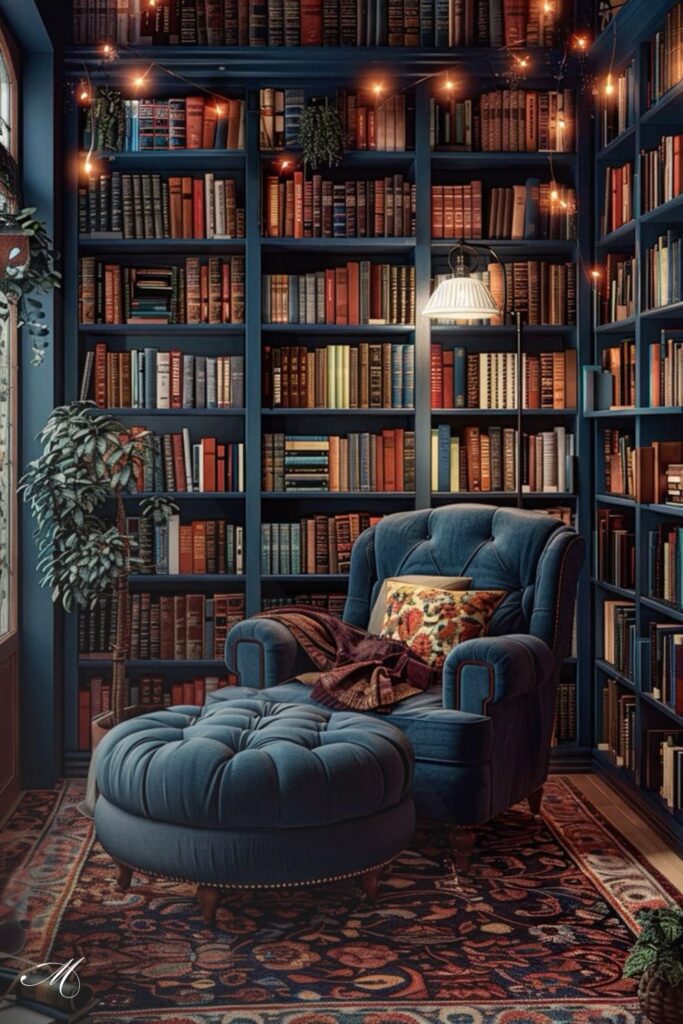
Deep navy built-in shelving, densely packed with leather-bound and cloth-cover books in burgundy, forest green, and cream, wraps a corner lit by warm string lights and a single dome task lamp. A tufted blue velvet wingback chair and a round tufted ottoman sit on a richly patterned red-and-navy rug, with a potted palm softening the corner.
Why it works: dark, saturated paint colors are usually a risk in a small room because they can feel cramped — but paired with warm lighting and jewel-toned upholstery, as this room shows, deep color actually makes a small reading nook feel enveloping rather than claustrophobic. The string lights threaded through the shelving keep the mood soft, and the velvet chair adds a tactile richness that a lighter fabric wouldn’t.
How to recreate it: this is one of the best options in the whole gallery for a small or low-light room, since deep colors read as intentional in dim conditions where pale finishes can look flat or grayish. Paint or reface existing shelving in a deep navy, forest, or burgundy, add a single richly upholstered chair, and lean on warm, low lighting rather than trying to brighten the room with cool white bulbs.
Light-Filled Layered Corner.
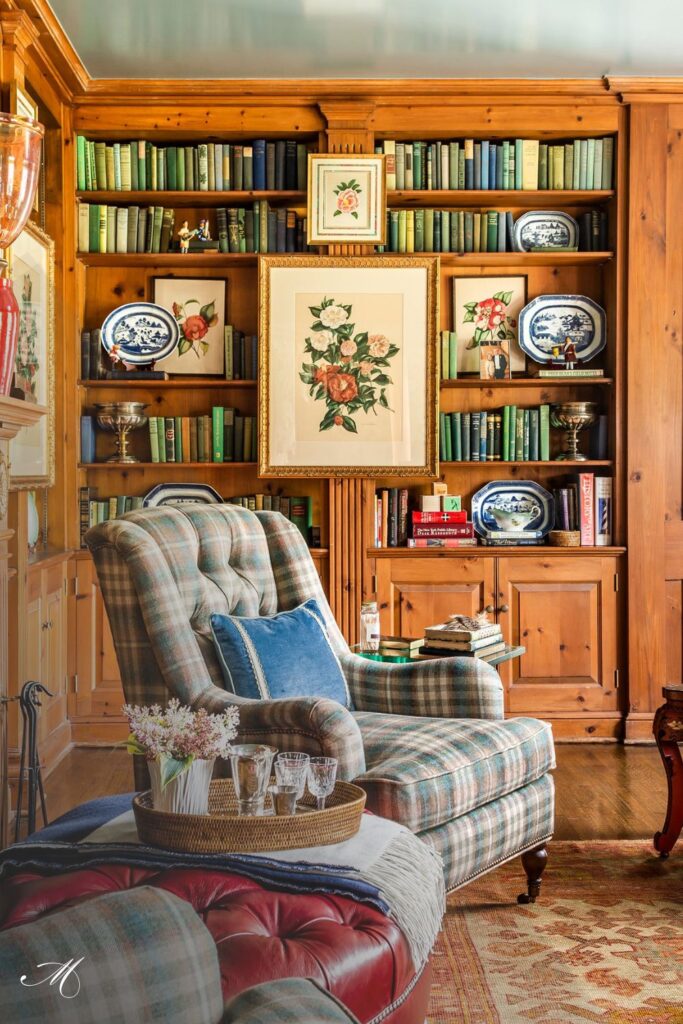
A softer, sunlit reading nook built around layered natural textures — woven seating, warm wood tones, and soft textiles — rather than heavy dark millwork. The emphasis here is on daylight and material warmth doing most of the visual work, with the shelving itself kept simple and secondary to the seating area.
Why it works: not every home has the ceiling height or budget for dramatic built-ins, and this idea shows that strong natural light and a few well-chosen textures can carry a reading corner just as effectively as elaborate shelving can. It’s a good reference specifically for homes that already have generous windows and want to work with that light rather than competing with heavier, darker finishes.
How to recreate it: if your reading spot already gets strong natural light, resist the instinct to add heavy, dark furniture to “ground” the room — instead, layer two or three natural textures (woven rattan, linen, raw wood) and let the daylight stay the dominant feature. A simple bookcase in a light wood tone will suit this approach far better than a large, dark custom built-in.
Intimate Reading Nook.
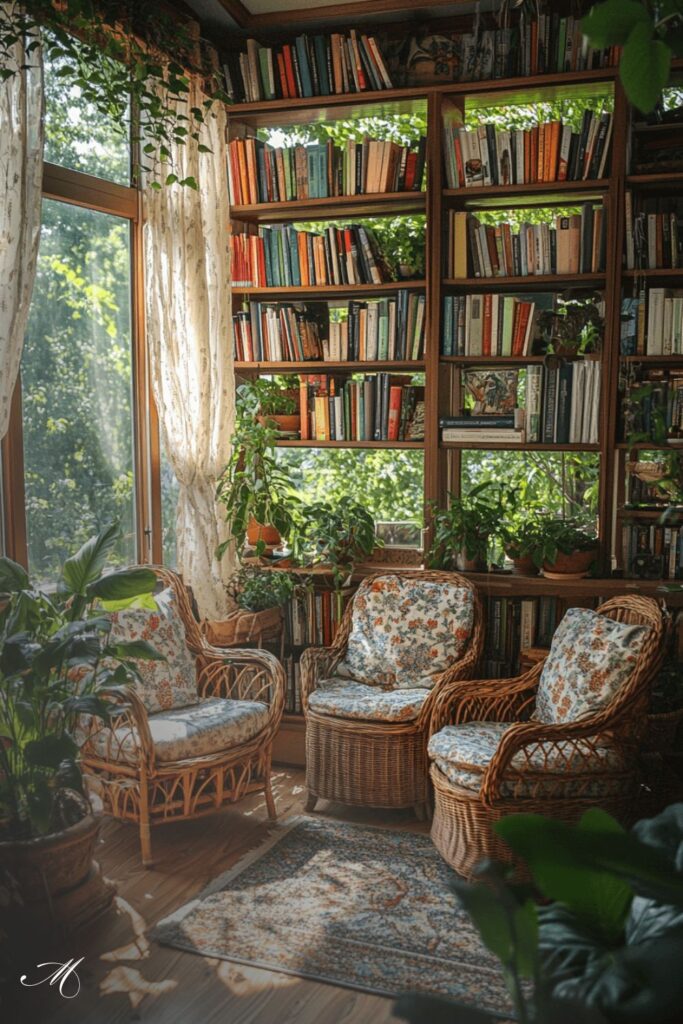
A smaller-scale, tucked-away corner built around exactly one purpose: a single chair, one focused lamp, and easy reach to a modest, curated shelf of books. There’s no attempt here to fill a whole wall or impress a visitor — the entire footprint is sized for one person to disappear into a book for an hour.
Why it works: this idea is a useful corrective to the rest of the gallery, most of which showcases large, dramatic rooms. It’s proof that the smallest possible version of a home library — a single chair, a single light, a small shelf within arm’s reach — still satisfies every fundamental covered earlier in this guide, and it’s often the most realistic starting point for a first-time home library project.
How to recreate it: this is the lowest-cost, lowest-commitment idea in the entire list. Pick any underused corner, add one genuinely comfortable chair, one warm-toned lamp, and a small shelf or stack of your current favorites within arm’s reach. There’s no shelving system or built-in required to start — this version can be assembled in an afternoon.
Storage-First Library.
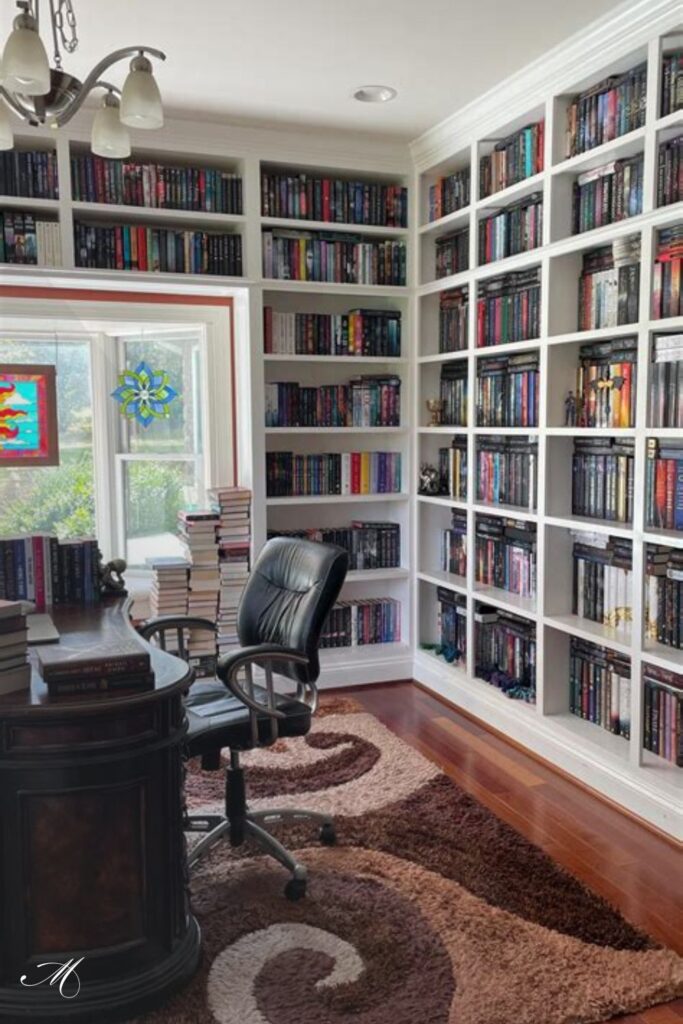
A setup that leans harder into raw shelving capacity than any other idea in this list, while still carving out one genuine seating area rather than sacrificing comfort entirely for storage. Dense, floor-to-ceiling shelving surrounds the room on multiple walls, with a desk or work surface integrated alongside the reading area.
Why it works: for a genuinely large or fast-growing book collection, atmosphere sometimes has to take a back seat to sheer capacity, and this idea shows how to do that without losing the “room to sit” fundamental entirely. Combining a workspace with the shelving also makes the room multi-purpose, which matters if you don’t have square footage to spare for a library that only does one job.
How to recreate it: if storage capacity is genuinely your biggest constraint, prioritize adjustable-height shelving (so you can adapt to oversized art books or paperbacks alike) over decorative styling, and make sure the desk or work surface doesn’t crowd out the one dedicated reading seat — it’s easy for a storage-first room to accidentally lose its only comfortable spot to sit.
Formal Rustic Library.
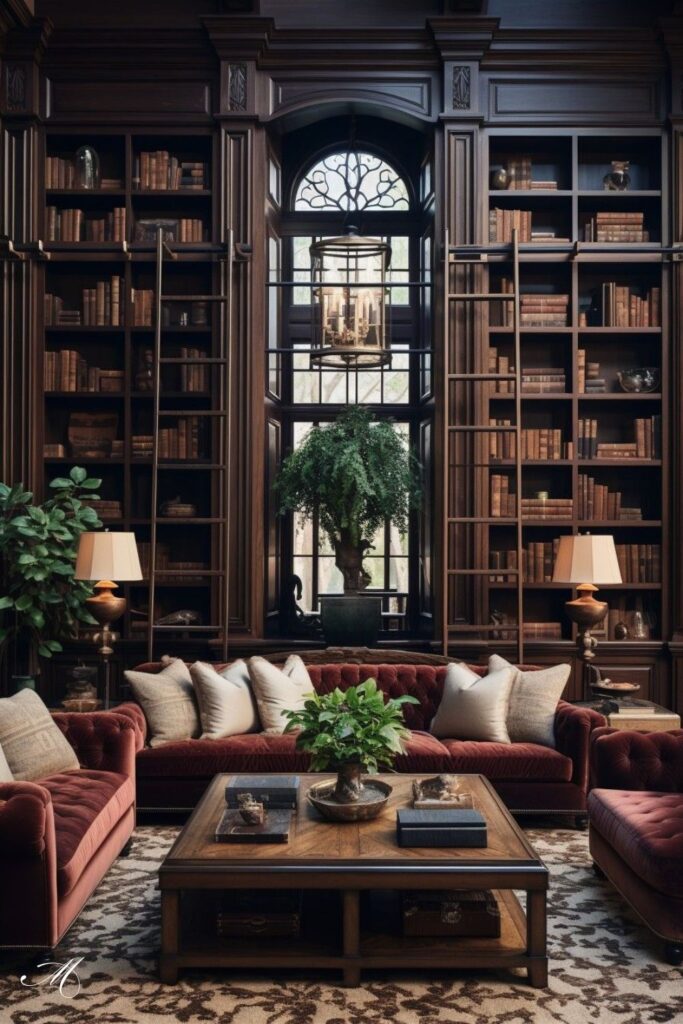
Dark wood paneling covers every wall floor to ceiling, with dual library ladders on brass rails serving two full walls of dense, leather-bound shelving. An arched window with an ornate iron transom and a hanging lantern-style chandelier forms the visual anchor, while a pair of deep burgundy tufted velvet sofas and a large square coffee table create a formal, substantial seating arrangement on a bold animal-print rug.
Why it works: this is the most dramatic rustic bookshelf idea in the entire gallery, and it works because every material commits fully to the same formal, old-world register — dark carved wood, brass hardware, leather bindings, and heavy velvet upholstery all reinforce each other instead of competing. Nothing in the room reads as an afterthought, which is what keeps a room this ornate from feeling like a theme rather than a real, functional space.
How to recreate it: full rustic millwork at this scale is a serious investment, but you can borrow the formula in a smaller den — a dark furniture wax or gel stain on existing wood shelving, one library ladder (even a short, freestanding version), and a single piece of substantial velvet or leather seating will carry most of this room’s character without the full custom build. Keep the rest of the palette limited to two or three tones (dark wood, brass, one jewel color) so it doesn’t feel busy.
How to Choose the Right Home Library Idea for Your Space
With sixteen directions to choose from, the fastest way to narrow it down is to answer three questions honestly before picking a style:
- How much natural light does the room get? Bright, window-heavy rooms (Ideas 1, 2, 13) suit a minimalist reading room or classic window library. Darker, low-light rooms actually look better leaning into rich, saturated color (Ideas 6, 12, 16) rather than fighting the light with all-white finishes.
- Is this a solo reading spot or a shared family space? A single deep armchair (Ideas 3, 12, 14) works for one dedicated reader. A daybed or sectional (Ideas 4, 11) works better for a household that wants the room to double as a hangout space.
- How large is your existing book collection, and how fast is it growing? If storage capacity matters more than atmosphere, lean toward the denser, taller setups (Ideas 5, 9, 15). If you’re keeping a small, curated shelf, a lighter, more editorial look (Idea 13) will feel intentional instead of empty.
There’s no wrong answer here — the point is matching the idea to how you actually live, not just how a photo makes a room look.
Home Library Ideas by Room Type
Different rooms come with different constraints, and the best home library idea for a spare bedroom rarely works in a stair landing. A quick room-by-room breakdown:
- Spare bedroom. The most flexible option — enough floor space for a full wall of shelving plus a proper reading chair, similar to Ideas 2 or 7. Good candidate for a full built-in if you’re ready to commit.
- Basement or den. Lower natural light makes this the ideal spot for a moody, saturated look like Ideas 6, 9, or 16, where warm lamp light does more work than daylight ever would.
- Attic or loft. Sloped ceilings pair surprisingly well with a modern double-height shelving wall and ladder (Idea 5), since the vertical space is already unusual.
- Home office corner. A single wall of shelving behind or beside a desk, styled like Idea 8 or Idea 13, adds a library feel without requiring a dedicated room.
- Stair landing or hallway. Best suited to a slim, shallow version of Idea 2 — a narrow bookcase with a single chair isn’t realistic here, but the shelving alone still reads as a mini library.
- Sunroom or converted porch. The natural home for a minimalist reading room like Idea 1 — let the windows do the visual work and keep the furniture minimal.
Home Library Ideas by Budget Tier
Not every idea in this gallery requires a contractor. Here’s roughly how the styles break down by investment level:
- Under $300 — Refresh what you have. A can of stain or paint on an existing bookcase, a secondhand armchair, a $40 thrift-store rug, and a table lamp can recreate the feel of Idea 3 or Idea 14 almost entirely with furniture you already own or can source secondhand.
- $300–$1,500 — Add real furniture. A quality reading chair, a modular shelving system (added to over time rather than bought all at once), and proper lighting gets you to something like Idea 2 or Idea 8.
- $1,500–$5,000 — Semi-custom built-ins. Paint-grade or stain-grade built-in shelving from a local carpenter, sized to your specific wall, can achieve the look of Idea 7 or Idea 11 without full custom millwork pricing.
- $5,000+ — Full custom millwork. The two-story libraries, curved walls, and ladder-and-rail systems in Ideas 5, 9, and 16 are largely custom builds, and pricing reflects the carpentry, hardware, and installation involved.
Whatever your tier, the fundamentals from earlier in this guide — a real reading seat, good lighting, a rug — matter more to how the room feels than which budget bracket you land in.
Small-Space Home Library Ideas (Apartments, Nooks, and Stair Landings)
Not every home has a spare room to dedicate, and most small-space home library ideas come down to reclaiming space nobody else is using:
- The stair landing library. A wide landing or the wall going up a staircase is often deep enough for a slim 8–10 inch bookcase and completely underused otherwise.
- The window seat conversion. If you have a deep windowsill or bay window, a built-in bench with shelving underneath and a slim shelf above turns a few square feet into a genuine reading nook, similar in spirit to Idea 2.
- The closet library. A shallow reach-in closet, doors removed, fitted with adjustable shelving, works surprisingly well as a mini home library — especially in a home office or guest room.
- The over-the-door solution. Slim over-the-door or floating ledge shelves add real capacity in small bedrooms without touching floor space at all.
- The room-divider bookcase. In an open-plan apartment, a tall, slim bookcase placed perpendicular to a wall can define a “library corner” within a larger living room without any construction.
Lighting, Rugs, and the Small Details That Make It Feel Like a Library
Once the shelving and seating are settled, the details are what separate a room with books from an actual library:
- Layer your light sources. A single ceiling fixture reads as utilitarian. Add at least one table lamp and, if possible, a picture light or LED strip along a shelf edge to wash the books in warm light, the way Ideas 3 and 12 use string lights.
- Choose warm bulb temperatures. Anything in the 2700K–3000K range reads as cozy; anything closer to daylight (5000K+) will make even the coziest farmhouse shelving feel clinical.
- Ground the room with a rug. Hard flooring under a bookcase and chair combination feels unfinished; a rug — vintage, patterned, or a simple wool flatweave — anchors the seating area visually.
- Leave breathing room on shelves. Books packed spine-to-spine with zero negative space reads as storage, not display. Leave small gaps for a plant, a framed print, or a stack of favorites laid flat.
- Add one soft texture. A throw blanket, a floor cushion, or a textured pillow does more to make a library feel used and lived-in than another decorative object would.
Common Mistakes to Avoid When Building a Home Library
A few issues show up again and again in home libraries that don’t get used as much as their owners hoped:
- Skipping the seat. Shelving without a genuinely comfortable place to sit turns a library into decorative storage. Buy the chair before you finish the shelves.
- Overcrowding every shelf. Zero negative space makes even beautiful millwork feel like a warehouse aisle. Leave gaps on purpose.
- Relying on one overhead light. It’s the single fastest way to make a cozy idea like Idea 3 or Idea 12 feel like a waiting room instead.
- Placing shelving too close to heat sources. Radiators, direct sun through unfiltered glass, and vents near a fireplace all warp covers and fade spines faster than most people expect.
- Building for a collection you don’t have yet. A half-empty custom built-in can look unfinished. If your collection is still small, start with a modular system like the budget-tier suggestions above and expand as you go.
How to Protect and Care for Your Home Library Long-Term
Once the room is built, a little maintenance keeps it looking like Idea 2 instead of a dusty stack of paperbacks:
- Control humidity. Books swell, warp, and mildew in damp conditions. A small dehumidifier in a basement library (Ideas 6, 9, 16) protects both the books and the wood shelving.
- Keep direct sun off spines. UV-filtering window film or sheer curtains protect against fading in sunroom-style setups like Idea 1, without sacrificing the light that makes the room work.
- Dust shelves, not just surfaces. A soft brush attachment every few weeks keeps dust from building up on the tops of pages, which is what actually causes long-term yellowing.
- Rotate the “currently reading” shelf. Keeping a small, changing selection near your reading chair (see the organization section below) means the most-handled books get the most attention, and the rest of the collection stays protected on higher, less-disturbed shelves.
How to Organize a Home Library You’ll Actually Use
A gorgeous shelf full of books you can never find isn’t much of a library. Once the design side is settled, organization is what keeps the space functional instead of just photogenic. A few approaches that hold up over time:
- By color, for pure visual impact. This is the fastest way to make any bookcase look intentional and is especially effective in modern home library design, where the shelving itself is minimal and the spines are meant to provide the color story. The tradeoff is that finding a specific title later takes longer.
- By genre or subject, for actual usability. Grouping fiction, reference, cookbooks, and travel guides separately makes a library feel more like, well, a library — and it’s the system most people fall back on once the color-coded phase wears off.
- By height, for a farmhouse or rustic look. Tallest books at the ends, shorter paperbacks toward the middle of a shelf, creates a natural, slightly uneven silhouette that suits collected, lived-in styles far better than a rigid grid.
- A “currently reading” shelf near the chair. Whatever system you use for the main collection, keep one small shelf or basket right next to your reading seat for the three or four books actually in rotation. It’s a small detail, but it’s the difference between a library that gets used daily and one where books quietly migrate to nightstands and never come back.
For a minimalist reading room in particular, organization also means editing. A curated shelf of thirty books you’ll return to says more than two hundred you’re storing out of guilt. Keep a small donation box nearby and revisit the collection once or twice a year — it keeps the room, and the design, feeling deliberate rather than accumulated by accident.
Home Library Idea Checklist Before You Start Building
Before committing to shelving, furniture, or a contractor quote, run through this short checklist:
- Picked a wall or corner with access to natural light, even indirect
- Chosen a reading seat first, before finalizing shelf design
- Measured shelf depth against your tallest and widest books (most standard shelves need at least 10–12 inches of depth for oversized hardcovers and art books)
- Planned at least one layered light source beyond the ceiling fixture
- Chosen a rug size that extends a few inches beyond the seating area, not just under the chair legs
- Left at least 10–15% of shelf space empty for growth and styling gaps
- Decided on an organization system (color, genre, or height) before shelving day, so books only get handled once
Where to Shop for Home Library Furniture and Shelving in the USA
If you’re sourcing pieces rather than building custom, a few categories of retailer come up repeatedly for home library furniture across the USA:
- Modular shelving systems from mainstream furniture retailers are the most budget-friendly way to start a wall of shelving that can expand over time.
- Mid-range furniture chains are a reliable source for library ladders, reading chairs, and larger built-in-style bookcases without a full custom order.
- Local carpenters and millwork shops are usually the better route once you want shelving sized precisely to an unusual wall, alcove, or ceiling height.
- Estate sales, thrift stores, and online marketplaces are worth checking first if you’re going for the collected, farmhouse, or rustic look — older wood furniture often has more character than anything new at the same price point.
Frequently Asked Questions About Home Library Ideas
How much space do I need for a home library? Less than most people expect. A single wall roughly 6 feet wide is enough for a meaningful bookcase-and-chair setup. Many of the small-space ideas above work in as little as 2–3 feet of depth.
What’s the best flooring for a home library? Hardwood or engineered wood with a rug layered on top is the most common choice, since it’s easy to keep clean and pairs well with any of the styles above, from modern to rustic. Carpet works too, especially in a quieter, more minimalist reading room.
Do built-in shelves add home value? In many markets, well-built custom shelving is viewed as a desirable, permanent upgrade, similar to a finished built-in closet system. It’s generally considered a safer investment than highly personalized paint colors or trend-driven finishes.
How do I keep books from fading in a sunlit reading room? Direct, all-day sun is the main culprit. UV-filtering window film or sheer curtains let the light in — which matters for a bright, minimalist reading room — while protecting spines from fading over time.
What’s a good starter piece if I can’t build a whole library at once? A single tall, adjustable-shelf bookcase paired with one genuinely comfortable chair. That combination alone captures most of what makes a home library idea feel real, and everything else can be added gradually.
Final Thoughts
The best home library ideas aren’t the ones that require the biggest budget or the most square footage — they’re the ones that get used. A single reclaimed shelf and a good chair by a window can hold more of that Powell’s-bookstore feeling than a picture-perfect built-in that nobody actually sits in. Start with the fundamentals — light, seating, reachable shelves, a rug underfoot — pick whichever of the sixteen ideas above feels closest to your own house, and let the rest follow from there. The room will tell you what it wants to become; you just have to give it the shelf space to start.

Lahiru N Gamage is the founder and editor of Modern Lifestyle Center, a lifestyle publication focused on home decor, interior design, beauty, fashion, garden inspiration, and modern living ideas. Through carefully researched articles and practical guides, he helps readers discover creative ways to improve their homes and everyday lifestyles.
Modern Lifestyle Center is committed to providing informative, trustworthy, and inspiring content designed to help readers create beautiful, comfortable, and functional living spaces.